
Tue, Apr 07
|New York
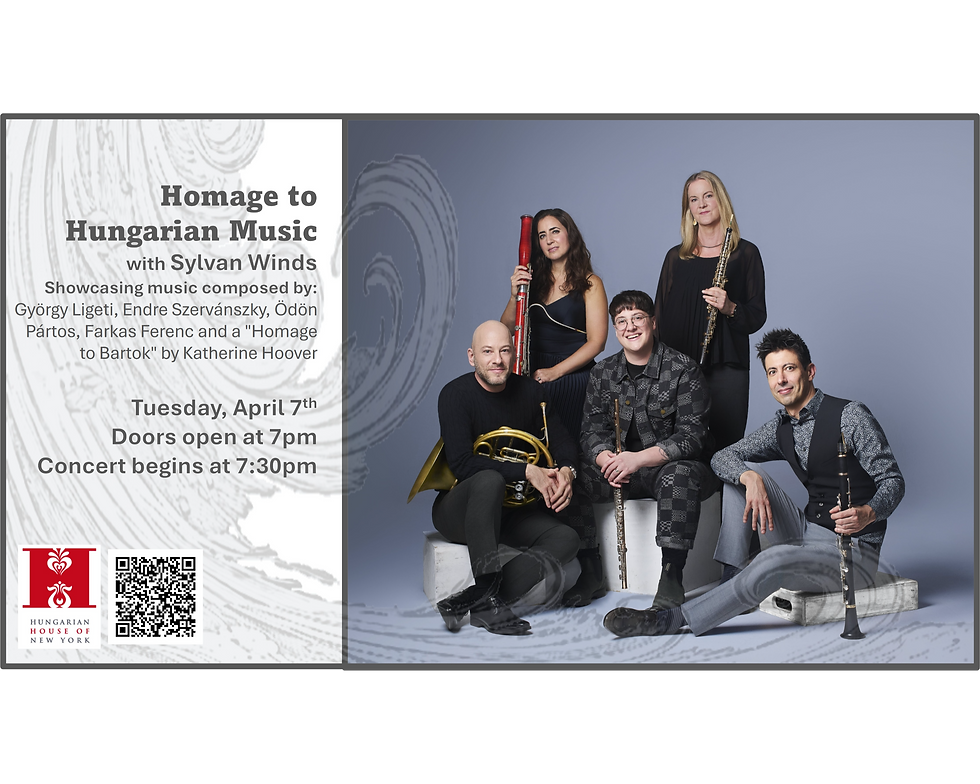
Homage to Hungarian Music with Sylvan Winds
A combination of delightful Hungarian rhapsodies performed exclusively with wind instruments.
Time & Location - Időpont
Apr 07, 2026, 7:30 PM – 9:00 PM
New York, 213 E 82nd St, New York, NY 10028, USA
About the Event - Részletek
Homage to Hungarian Music
TUESDAY, APRIL 07, 2026, 7:30 PM
The Hungarian House of New York
Spanning 400 years of works by Hungarian composers. A combination of delightful Hungarian rhapsodies performed exclusively with wind instruments with works by György Ligeti, Ferenc Liszt, Endre Szervánszky, Ferenc Farkas, and Katherine Hoover's Homage to Bartók.
Egy koncert a 400-éven át klasszikus zeneipart formáló magyar származású zeneszerzők tiszteletére, a New York-i Sylvan Winds együttes előadásában, egy különleges meglepetésvendéggel.
Performing in important historic and cultural New York City buildings, Sylvan Winds ensemble creates imaginative and informative programs that reflect the environs of each space. This program brings together pieces spanning four centuries of works written by Hungarian composers. The Sylvan Winds ensemble is an integral part of New York City's cultural offerings, and has earned both critical and audience acclaim for its spirited performances and innovative programming by exploring the entire body of work of chamber music for wind instruments.
performed by: Amir Farsi (flute), Kathy Halvorson (oboe), Nuno Antunes (clarinet), Gina Cuffari (bassoon), Zohar Schondorf (horn)
PROGRAM
FERENC FARKAS (1905-2000) Early Hungarian Dances from the 17th Century
FRANZ LISZT (1811-1886) Eglogue from Years of Pilgrimage
KATHERINE HOOVER (1937-2018) Homage to Bartok
GYÖRGY LIGETI (1923–2006) Sechs Bagatellen
ENDRE SZERVÁNSZKY (1911-1977) Wind Quintet No. 1
Program subject to change

About Sylvan Winds:
The SYLVAN WINDS, an integral part of New York City's cultural offerings, has earned both critical and audience acclaim for its spirited performances and innovative programming. Exploring the entire body of work of chamber music for wind instruments, it is the only group of its kind to present an annual concert series in New York City that was inaugurated at the historic Church of St. Luke in-the-Fields in Greenwich Village. The ensemble celebrated its 40th Anniversary during the 2018-19 season.
The Sylvan Winds have garnered numerous commissioning, recording, residency, and general support grants from the National Endowment for the Arts, Chamber Music America, the New York State Council on the Arts, the NYC Department of Cultural Affairs, and Meet the Composer, now NewMusicUSA.
Recent initiatives include exploring music from different cultures - notably "Sounds of the Americas," "Russian Nights," “Harlem Mosaic,” "Scandinavian Winds," and "Slavic Soul" – as well as a historical series of concerts "From the Library of Georges Barrère." Many of the works they perform are written for a variety of instrumental groupings and have included collaborations with such illustrious guest artists as conductors Gerard Schwarz and Ransom Wilson, the Guarneri String Quartet, pianist Claude Frank, harpsichordist Kenneth Cooper, harpist Kristi Shade, guitarists Oren Fader and Pedro Da Silva, mezzo-soprano Wendy White, narrator Robert Sherman, actor Louis Zorich, and the American Brass Quintet.
About the featured composers:
Ferenc FARKAS (1905–2000, born in Nagykanizsa) was a pivotal 20th-century Hungarian composer and educator known for blending Mediterranean lyricism with Hungarian folk traditions and modern techniques. Educated in Budapest and under Ottorino Respighi in Rome, he produced over 700 works, including operas, ballets, and acclaimed film scores. As a professor at the Franz Liszt Academy of Music in Budapest (1949–1975), he influenced major composers like Ligeti and Kurtág. Known for his versatile, expressive style, his famous pieces include Early Hungarian Dances.
Franz LISZT (1811–1886, born in Raiding) was a Hungarian composer, virtuoso pianist, and conductor, widely regarded as one of the most influential musicians of the Romantic era. A child prodigy, he revolutionized piano technique and performance, effectively inventing the modern solo piano recital. Known for his incredible charisma and showmanship, he commanded international fame, pioneering the “symphonic poem”; form and expanding harmonic language. As a prolific composer, his masterpieces include the Hungarian Rhapsodies, Years of Pilgrimage, and his piano concertos. Later in life, he dedicated himself to teaching, composing sacred works, and mentoring younger composers in Weimar. Liszt significantly elevated the role of the pianist and left an enduring legacy on Western classical music.
Katherine HOOVER (1937–2018, born Elkins WV) was a distinguished American composer, flutist, and educator who became a pioneering voice for women in classical music. Renowned for her ”pictorial” and ”romantic” style, she often drew inspiration from Native American themes, as heard in her famous solo flute work, Kokopeli. A graduate of the Eastman School of Music, Hoovers prolific catalog of over 90 works includes chamber music, orchestral tone poems like Eleni, and concertos for varied instruments. She was a two-time finalist for the Kennedy Center Friedheim Award and received the National Flute Association’s Lifetime Achievement Award in 2016. To maintain artistic independence, she co-founded Papagena Press in 1988 to publish her own compositions.
György LIGETI (1923–2006, born in Transylvania) was a towering figure of the 20th-century avant-garde, celebrated for his innovative ”micropolyphony” which is a technique of dense, shifting textures. Born to a Hungarian-Jewish family in Transylvania, he survived a Nazi labor camp and later fled the 1956 Hungarian Revolution for Vienna. Ligeti achieved global fame when his haunting works, including Atmosphères and Lux Aeterna, were featured in Stanley Kubrick’s 2001: A Space Odyssey. His diverse output ranges from the absurd opera Le Grand Macabre to his rhythmically complex Piano Études, which earned him the prestigious Grawemeyer Award. A restless experimenter, he received the Polar Music Prize in 2004 for stretching the boundaries of the musically conceivable.
Endre SZERVÁNSZKY (1911–1977, born in Kistétény) was a pivotal Hungarian composer and educator whose work bridged the gap between national traditions and the modern avant-garde. Initially influenced by the folk-infused styles of Béla Bartók and Zoltán Kodály, his early compositions, such as his popular Wind Quintet No. 1, were noted for their lyrical accessibility. As a professor at the Liszt Ferenc Academy of Music, Szervánszky became a courageous innovator. In 1959, he composed Six Orchestral Pieces, the first Hungarian work to employ twelve-tone serialism, effectively opening the door for the next generation of experimental composers. Beyond music, he was posthumously honored by Yad Vashem as Righteous Among the Nations for risking his life to save Jewish individuals during the Holocaust.
This concert is made possible, in part, with public funds from the New York State Council on the Arts, with the support of the Governor and the New York State Legislature, in part, by public funds from the New York City Department of Cultural Affairs in partnership with the City Council, and in part, with funds from the Music Performance Trust Fund.
This concert is FREE to the public, but reservations are required.